


News Center
--
Because of the reform and the birth, because of the reform and prosperity, because of the reform and strong
A More Practical T-Girder Formwork for Bridge and Road Construction
Oct 14,2021
A T-beam is a beam with a T-shaped cross section, in which the two selected flange portions are referred to as the flanges and the central portion as the web. Since the concrete in the flange region essentially serves only to resist tensile forces—without contributing to flexural strength—the overall flexural capacity remains identical to that of a conventional rectangular section. This design not only saves concrete but also reduces the self-weight of the member, thereby enhancing its span-carrying capability. As the width of the flange increases, the height of the compression zone in the T-shaped section decreases, which in turn increases the internal moment arm and the resulting bending moment. Currently, in bridge and road construction, there is a T-beam formwork There are multiple gaps between the T-beam formwork body and the T-shaped girders. Thanks to the large contact area between the multiple pressure plates and the T-shaped girders, the precast T-shaped girders’ surface integrity can be maintained, while the T-beam formwork also reduces demolding tension and accelerates the demolding process. However, in practical applications, the supporting formwork is subjected to substantial loads, which is detrimental to the concrete placement of the T-beams.
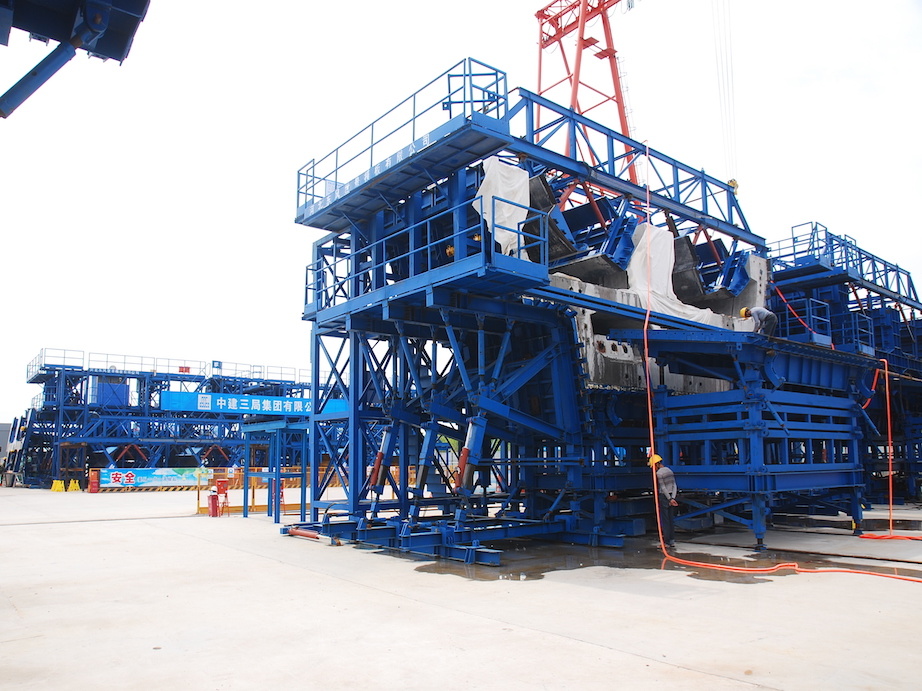
To overcome the aforementioned shortcomings in the existing technology, technicians have provided a device for road and bridge construction. T-beam formwork To achieve the aforementioned objectives, the T-beam formwork adopts the following technical solution: a T-beam formwork for road and bridge construction, comprising a side formwork 1; one side of side formwork 1 is provided with a second side formwork 2; the bottom of each second side formwork 2 is equipped with a formwork base; and each second side formwork 2 is securely fastened to its corresponding formwork base via bolts. One end of the first mounting bracket is connected to a top rod, while the second mounting bracket is rigidly fixed to the upper end of the formwork base; the structure of the second mounting bracket is identical to that of the top rod. The surface of the second mounting bracket is provided with positioning holes, within which positioning screws are installed; the positioning screws are threadedly engaged with the corresponding threaded holes. T-beam formwork
Specifically, multiple reinforcing bars are arranged between the support mold and the formwork, with the bars configured in a triangular pattern and equipped at their bases with reinforcing transverse plates. The two ends of each reinforcing transverse plate are rigidly connected to one end of the support mold and one end of the formwork, respectively. A T-shaped groove is provided between the first side form and the second side form. Cylinder actuators are mounted on both sides of the bottom of the first mounting bracket, and a pressing plate is positioned between every pair of adjacent reinforcing rods; the piston rod of each cylinder is rigidly connected to one end of the corresponding pressing plate. One side of the pressing plate is fitted with a rubber washer, the end of which is in contact with the inner wall of the formwork.
This new type T-beam formwork The invention provides the following technical effects and advantages: First, by providing a push rod, positioning screws, and mounting holes, with each end of the push rod respectively seated in mounting base 1 and mounting base 2, the mounting holes and positioning holes are aligned on the same horizontal plane. One end of the positioning screw is inserted into the mounting hole, thereby connecting the push rod to mounting bases 1 and 2, providing auxiliary support for the mold and preventing excessive internal forces on the supporting mold caused by the T-shaped beams within the T-shaped grooves, thus ensuring the stability of side molds 1 and 2. Second, by providing a pressure plate and a cylinder, the extension of the cylinder’s piston rod drives the pressure plate and rubber gasket toward the formwork side, which assists in pressing the T-shaped beam against the formwork, facilitating the forming of the T-shaped beam and preventing uneven stress on the T-shaped beam during the concrete pouring process.

Hotline:


Fax:

Email:
Hebei Dongfeng Shijing Railway Co., Ltd.
Company culture:What others cannot do, we can do; what others can do, we will do better.
Enterprise mechanism: quality training, selection and appointment, strict management, positive incentives.
Enterprise Management: Principles in major matters, understanding in small matters, cooperation in handling matters.
Message Board
We will contact you within one working day. Please check your email.