


News Center
--
Because of the reform and the birth, because of the reform and prosperity, because of the reform and strong
What is the construction process for cable-stayed hanging baskets?
Oct 08,2021
Cable-stayed basket The installation of the cable‑pulling basket is carried out in conjunction with the construction of Main Girder Section 01, with the basket assembled as an integrated unit and installed on the universal component support platform at the top of the tower pier. Once the load‑bearing platform is properly positioned, the basket’s load‑bearing platform serves as the scaffolding platform for constructing Main Girder Section 01. Upon completion of Section 01, modifications are made to the basket’s C‑shaped hooks, arch frames, and traveling idler rollers, after which the basket is moved forward to Main Girder Section 2, thereby entering the cantilever‑casting phase of the cable‑pulling basket. Depending on site conditions, the basket can be installed on the ground using various methods, such as full‑height lifting.
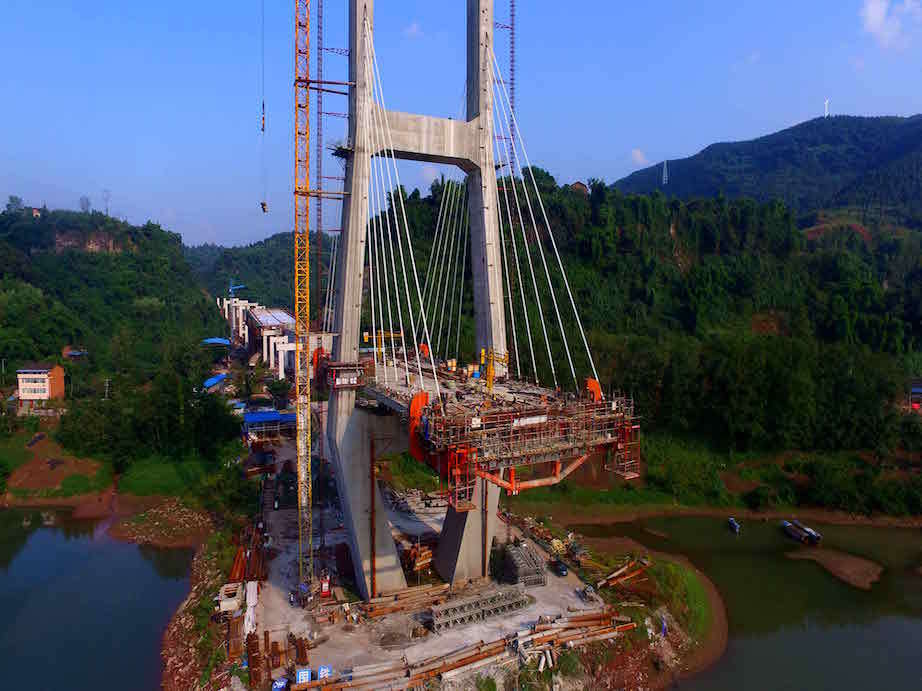
1. Ballast Test for the Cable-Stayed Hanging Basket
After the stay cables and hanging basket have been assembled and anchored, a preloading test must be conducted to verify whether the actual internal force state and deformation of the structure are consistent with the design. The preloading load shall be no less than 1.2 times the bearing capacity of the hanging basket, and the load may be applied in stages using methods such as simulation, so as to match the actual loading conditions of the hanging basket as closely as possible.
The stress conditions are consistent. Due to factors such as pier height and terrain, the counter-support preloading method can be used for ballast testing. Cable-stayed form traveler
2. Key Operational Points
(1) The suspended platform moves forward.
Once the suspended platform has been lowered into position, the bottom sliding mechanism of the C-shaped hook rests on the sliding steel plate on the girder surface, and the reverse travel rollers have been installed. Upon release of all anchor rod restraints, the suspended platform is ready to move forward. A 100-ton jack is mounted on the side of the C-shaped hook to provide the pushing force. The C-shaped hook then slides along the sliding steel plate toward the end of the girder, thereby advancing the suspended platform. The contact surfaces between the sliding steel plate and the sliding bearings of the shift lever are lubricated to minimize friction. During forward movement, the suspended platform must be advanced smoothly and without any damage or deviation; if any deviation occurs, it shall be corrected promptly. Alternatively, the suspended platform can also be advanced by using a jack to pull the C-shaped hook.
(2) Cable-stayed basket It shall be properly anchored to form a forward fulcrum.
Once the suspended platform has been moved forward into position and its planar location has been verified to comply with code requirements through surveying and layout, the anchorage system rods are installed. The rear jack on the main longitudinal girder is then used to flip the top and bottom surfaces of the girder; the traveling flip rollers are lowered, and the girder-surface jacks are employed to lift the middle-girder anchor rods, thereby raising the suspended platform. During the lifting process, the jacks at the rear of the main longitudinal girder simultaneously retract their cylinders, ensuring smooth and stable ascent of the suspended platform until the bottom formwork of the main ribs is close to the bottom surface of the cast-in-place beam. Next, the fine-adjustment lifting mechanism and the thrust device structure for the suspended platform are installed, along with the anchorage system for the platform. The positions of the anchor bearing plates for the suspended-platform traction system are then surveyed and laid out. After the cables are suspended at the tower end, the beam
The stay cable passes through the cable conduit, with the anchor head installed on the upper fork of the towing cable system. A truck-mounted crane, in conjunction with a winch, applies tension to the anchor, enabling the upper fork to hinge with the lower fork of the basket’s towing cable system and thereby establishing a forward fulcrum for the basket. The inclined stay cable passes through the basket’s towing system tie rod and is anchored via an anchoring nut secured to the arc-shaped spherical anchor plate; the design position of the inclined stay cable’s anchor ring must be kept at a specified distance from the cable conduit’s anchor pad separation plate. Towing cable hanging basket
(3) Adjustment of the Elevation of the Suspended Formwork for the Stay Cables
The cable-stayed basket formwork primarily comprises the bottom form, inner top form, outer form, and inner form. The main reinforcement bars and transverse diaphragm bottom form are welded to the lifting basket, allowing for installation and removal via basket lifting. The inner top form rises and falls with the arch support frame, facilitating its installation and dismantling. Installation and removal of the inner and outer forms are carried out in coordination with truck cranes and other lifting equipment. The elevation of the basket formwork is adjusted by the jacks located at the rear of the main longitudinal girder. Cable-stayed basket

Hotline:


Fax:

Email:
Hebei Dongfeng Shijing Railway Co., Ltd.
Company culture:What others cannot do, we can do; what others can do, we will do better.
Enterprise mechanism: quality training, selection and appointment, strict management, positive incentives.
Enterprise Management: Principles in major matters, understanding in small matters, cooperation in handling matters.
Message Board
We will contact you within one working day. Please check your email.