

News Center
--
Because of the reform and the birth, because of the reform and prosperity, because of the reform and strong
What is a cable-stayed hanging basket?
Oct 05,2021
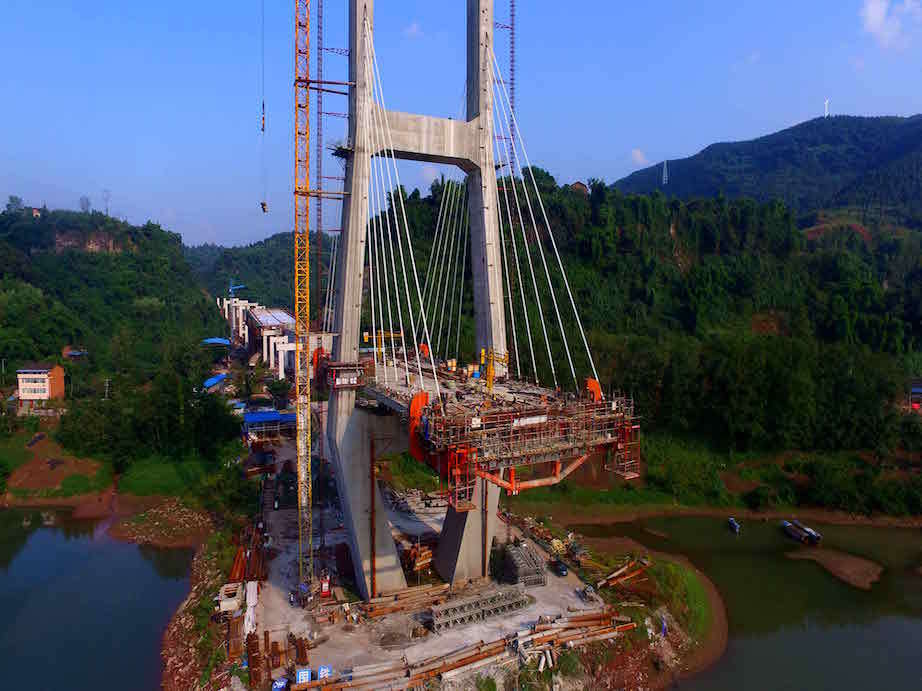
Cable-stayed basket Also known as the front-pivot hanging basket, it is a piece of equipment used in the cantilever concrete placement construction of the main girders of cable-stayed bridges and represents a new type of suspended working platform that has reached an internationally advanced level. Since the completion of the Tongling Yangtze River Highway Bridge in Anhui Province and the subsequent adoption of cable-stayed hanging baskets, this technology has been widely applied to large-span, large-section concrete cable-stayed bridges such as the Wuhan Yangtze River Second Bridge and the Nanchang Xinba Bridge. Furthermore, cable-stayed hanging-basket construction techniques have been extensively employed in the construction of highway bridges, including the Wuhan Jianghan Fourth Bridge, the Yueyang Dongting Lake Bridge in Hunan Province, the Poyang Lake Bridge in Jiangxi Province, and the Jingzhou Yangtze River Bridge in Hubei Province.
1. Construction Principle of the Cable-Suspended Formwork
The front fulcrum traction cable of the suspended platform is configured as a stay cable, while the rear anchorage point is anchored to the bottom slab of the already cast girder segment and supported by C-shaped hooks resting on the top surface of the cast-in-place main girder. This change in the load distribution—shifting from a cantilevered configuration at the rear anchorage point to a bi-supported arrangement—reduces the deflection and bending moment of the suspended platform, thereby enhancing its load-carrying capacity. Furthermore, the entire cross-section of the main girder is cast in a single operation.
2. Cable-stayed basket Characteristics of the process method
The structure adopts a steel box design, which is compact, highly integral, boasts high stiffness and load-carrying capacity, and offers superior safety. The cable-stayed form traveler employs a combined force-transmission system that integrates suspension with cable-stayed traction, thereby extending the length of each cross-section during construction, enhancing standardization, accelerating construction speed, improving construction quality, while also resulting in greater weight and higher fabrication costs.
The cable-stayed hanging basket, serving as the load-bearing structure for cantilever concrete placement of the main girder, is anchored to the main girder via an anchorage system.
On the bottom formwork, the cable-stayed cables are connected to the basket’s curved head via a traction system, forming a simply supported structural load-bearing platform. Subsequently, operations such as formwork support, rebar tying, concrete placement, prestressing tensioning, and grouting are carried out on the suspended working platform.
During cantilever construction with the suspended formwork, the stay cables are tensioned in three stages. The first tensioning is carried out after the suspended formwork has been properly anchored and the formwork has been installed at the correct elevation; the second tensioning is performed when half of the concrete has been placed; and the third tensioning is conducted upon completion of concrete placement. The prestress levels for both stages are identical. Subsequently, the prestressing of the girder and the modification of the suspended formwork’s arc-head-to-main-girder stay-cable anchorage system are executed. To balance the horizontal forces generated by the stay cables, a thrust mechanism is installed between the suspended formwork and the main girder. As the suspended formwork advances, a C-shaped hook suspends it from a sliding plate on the top surface of the main girder, and a traveling reverse roller pushes the C-shaped hook onto the jack. When the bottom sliding device moves, the suspended formwork advances. The lifting of the suspended formwork is accomplished by operating the jack. Stay-cable suspended formwork
3. Cable-stayed basket Construction method
According to the design drawings, Segment 01 of the main girder will be constructed using pier-side scaffolding, with the launching gantry commencing cantilever erection from Segment 2. Taking into account site conditions, during construction of Segment 01, the launching gantry’s foundation pad will be utilized as the construction platform: the foundation pad will be directly assembled, welded, translated laterally, and jacked up onto the scaffolding adjacent to the bridge pier. The pier-side scaffolding will employ universal tension rods, and these components will be assembled at the top of the tower pier. After the launching gantry is assembled and hoisted into place, support brackets will be installed at the rear end of the gantry, while inclined brackets will be provided at the front end; diagonal steel supports will also be installed at the midspan of the gantry’s main longitudinal girder to meet the structural requirements of Segments 0 and 1.
The cable-stayed hanging basket, serving as the load-bearing structure for cantilever concrete placement of the main girder, is anchored to the main girder via an anchorage system.
On the bottom formwork, the stay cables are connected to the basket’s curved head via a traction system, forming a simply supported structural load-bearing platform. Subsequently, operations such as formwork support, rebar tying, concrete placement, prestressing tendon tensioning, and grouting are carried out on the suspended working platform. During cantilever construction with the suspended basket, the stay cables are tensioned in three stages.

Hotline:


Fax:

Email:
Hebei Dongfeng Shijing Railway Co., Ltd.
Company culture:What others cannot do, we can do; what others can do, we will do better.
Enterprise mechanism: quality training, selection and appointment, strict management, positive incentives.
Enterprise Management: Principles in major matters, understanding in small matters, cooperation in handling matters.
Message Board
We will contact you within one working day. Please check your email.